Think using just a few seconds won’t count as infringement?
The court ruled: if it can substitute for viewing the original, it is infringement.
During the 2020 Tokyo Olympic Games, a platform clipped competition footage broadcast by CCTV into GIFs and screenshots and posted them on its website.
The content covered 41 events, all featuring championship wins and highlight moments, and attracted more than 2 million views.
The infringement occurred in 2020, and the judgment was issued in 2025.
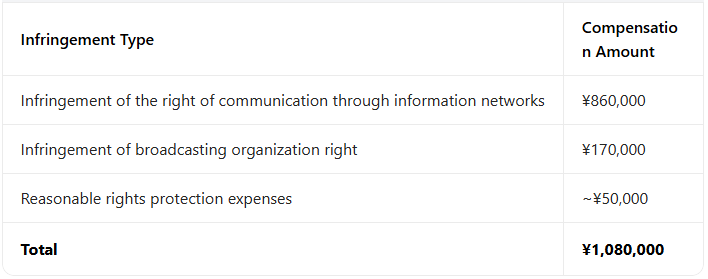
The defendant was ordered to pay
1.08 million yuan in compensation.
This case remains a landmark precedent for infringement involving fragmented communication of sports events to this day.
I. Why Does a 7-Second GIF Constitute Infringement?
The defendant argued:
-
Each GIF lasted only a few seconds, accounting for a tiny proportion of the full competition
-
It constituted fair use "for news reporting"
The court rejected both claims.
Core logic: Liability does not depend on length, but on the substitution effect.
The court held:
Although short, the GIFs captured the absolute highlights of the events—goals, championship victories, and key rulings.
Users who viewed these GIFs had little need to watch the full event replays.
This created a real substitution effect on the original copyrighted sports content.
Holding:
Even if the used footage accounts for a minimal proportion of the whole, if it condenses the core highlights and provides users with a complete viewing experience, it constitutes infringement.
Reminder for professionals:
The criteria for finding a "substitution effect" include:
-
Whether key segments or highlight moments of the event are selected
-
Whether the collection of fragmented content covers the main attractions of the competition
-
Whether users reduce their consumption of the original content as a result
II. How Was the ¥1.08M Calculated?
The amount was determined through detailed judicial calculation:
Why is broadcasting organization right calculated separately?
The 2020 revised
Copyright Law expanded the protection of broadcasting organization rights from "wireless broadcasting" to "cable, satellite and internet communication". The defendant’s clip and dissemination of CCTV footage infringed CCTV’s right of retransmission as a broadcasting organization.
Why such a high award?
The court considered the defendant’s
subjective malice:
-
CCTV issued a copyright statement before the Games
-
The National Copyright Administration listed the events on its key protection list
-
The defendant sent representatives to a copyright protection coordination meeting and fully understood the rules
Deliberate infringement + large-scale dissemination + strong timeliness of sports events → high compensation.
III. Why Is "Pausing Broadcast for One Minute" Insufficient for Platforms?
You may ask: What does this have to do with me if I don’t make GIFs?
Another case decided around the same time provides the answer.
A platform received a complaint that a user was streaming pirated competitions.
The platform’s response: "black out the stream for one minute" and then resume it.
The court ruled:
This constituted "measures clearly insufficient to stop infringement".
Where a platform has the ability to proactively detect and promptly remove infringing content, performing perfunctory actions amounts to
contributory infringement.
For popular sports events, platforms bear a higher duty of care:
-
Proactive monitoring: Do not wait for complaints; use keywords, AI recognition and other technical means to detect infringements
-
Decisive removal: